Organic Paint AI
A Human Centered Exploration of Color, Creativity, and Ethical AI Design
Process of uploading a photo of strawberries to Organic Paint AI and the output of paint mixing recipes.
Organic Paint AI
Organic Paint AI is a supportive creative tool designed to help artists understand color rather than automate the act of making. It identifies colors from photographs and translates them into practical pigment mixing guidance for oil, acrylic, watercolor, tempera, and soft pastels, allowing artists to remain fully engaged in the creative process. The tool was created for artists, designers, and anyone who wants to explore color with intention, curiosity, and control, rather than relying on systems that generate finished work on their behalf.
The project emerged from a growing concern I observed in the creative technology space, where many AI tools prioritize speed and output over learning, process, and meaning. As generative systems become more common, the role of the artist is increasingly reduced to writing prompts, distancing creators from materials, observation, and decision making. Organic Paint AI was intentionally designed as an alternative to that trend. Its purpose is to support creative growth, reinforce artistic agency, and help users build confidence through understanding how color behaves in the real world.
At its core, Organic Paint AI reflects my belief that technology should work alongside people rather than replace them. By focusing on color theory, pigment behavior, and real-world application, the tool strengthens the connection between the artist, their materials, and their environment. This case study explores how Organic Paint AI was researched, designed, and built, and how human centered and ethical AI principles guided every decision throughout the process.
The Problem I Set Out to Solve
The rapid rise of AI generated art tools has fundamentally altered how creativity is framed, valued, and practiced. Many of these systems promise efficiency and instant results, yet they do so by removing the artist from the most meaningful parts of the process. Observation, experimentation, material understanding, and decision making are often replaced by automated outputs that require little engagement beyond a written prompt. While this approach may increase production, it diminishes the depth, learning, and personal connection that have historically defined artistic practice.
For many artists, especially beginners and students, color remains one of the most difficult aspects of making art. Translating what is seen in the world into accurate pigment mixtures requires years of practice, and existing tools rarely support this learning in a practical, accessible way. Digital color pickers provide numeric values that do not translate to physical materials, while generative AI tools bypass the challenge entirely by producing finished images. This leaves a gap between observation and execution, where artists are left without guidance that respects both their agency and their need to learn.
At the same time, ethical concerns surrounding AI in creative spaces continue to grow. Generative systems are often trained on opaque datasets, raising questions about authorship, bias, and consent. These tools increasingly shape creative workflows in educational and professional environments, yet they rarely prioritize transparency, inclusivity, or human centered design. As AI becomes more embedded in creative practice, the absence of supportive, ethical alternatives becomes more visible.
Organic Paint AI was created in response to these overlapping challenges. The problem was not a lack of creative tools, but a lack of tools that support artists without replacing them. I set out to design an AI system that assists with understanding color, reinforces learning, and preserves the human role in the creative process. The goal was to bridge the space between digital observation and physical making, offering guidance that strengthens confidence and skill while keeping creativity firmly in human hands.
Goals and Design Principles
From the beginning, the goal of Organic Paint AI was not to create another tool that produces art automatically, but to design a system that supports the artist while preserving the integrity of the creative process. Every design decision was grounded in the belief that creativity is learned through observation, experimentation, and physical engagement with materials. The tool needed to assist without taking control, guide without dictating, and educate without overwhelming. This required restraint as much as innovation, especially in a landscape where generative shortcuts are often prioritized.
One of the primary goals was to strengthen artistic autonomy. Organic Paint AI was designed to help users understand what they are seeing in the world and how to translate that into paint, rather than doing the work for them. Color identification, pigment recipes, and technique guidance are presented as options and explanations, not as final answers. This approach allows artists to make informed decisions, compare results, and build confidence over time, which is especially important for students and emerging creatives who are still developing their intuition.
Accessibility and clarity were also central to the design. Color theory can feel intimidating, and many artists struggle not because they lack creativity, but because the language and systems used to explain color are difficult to apply in practice. The interface was intentionally kept simple and approachable, with clear visual hierarchy and readable explanations that support learning in the moment. The goal was to create a tool that feels welcoming rather than technical, one that meets artists where they are rather than requiring specialized knowledge to get started.
Ethical responsibility shaped the project as much as usability. Because the tool processes photographs, it was important to design with fairness, transparency, and inclusivity in mind. Organic Paint AI does not generate images, mimic artistic styles, or replace authorship. Instead, it focuses on interpretation and education, reducing the risk of misrepresentation or creative displacement. Research on bias in image interpretation and human centered AI reinforced the importance of being intentional about how color is analyzed and communicated, especially across different lighting conditions, environments, and subjects.
Finally, the long-term design vision was rooted in reconnection. Rather than pulling artists further into digital spaces, Organic Paint AI is intended to bring them back into their surroundings, encouraging closer observation of light, color, and material relationships in the physical world. This principle guided not only the current web-based prototype, but also future concepts such as a portable mechanical palette that supports painting on location. At every stage, the design goal remained the same, to create AI that supports learning, deepens engagement, and keeps creativity unmistakably human.
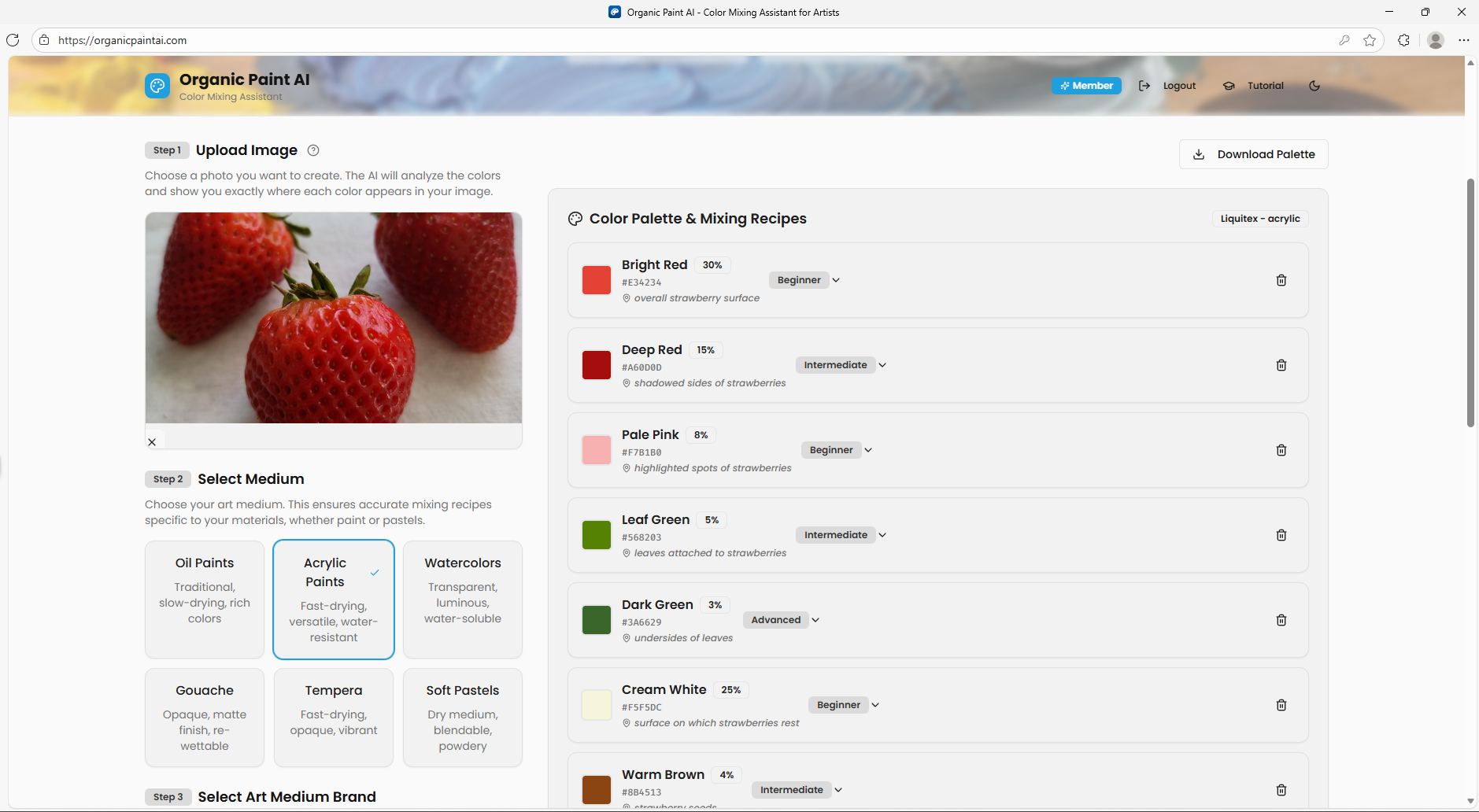
Analysis of a photo of strawberries showing color palette and mixing recipes. Accurate information is populated based on medium and paint brand. User can click on the colors to learn how to mix the colors with accuracy.
Process, Tools, and How the Work Took Shape
The development of Organic Paint AI followed an iterative and reflective process that blended research, design thinking, and hands on experimentation. Rather than beginning with a fixed technical solution, I started with questions about purpose, impact, and responsibility. I wanted to understand not only what the tool could do, but what it should do, and how each design choice would affect the artist’s experience. This mindset shaped the entire process and influenced how I approached both the technical build and the interface design.
I built the functional prototype using Replit and its AI powered vibe coding environment. This approach allowed me to work conversationally, translating design intent into written prompts that guided the system’s behavior. Instead of writing traditional code line by line, I described interactions, logic, and constraints in natural language, then refined the output through repeated testing and adjustment. This method made the process accessible while still demanding precision, because small changes in phrasing could significantly affect how the system interpreted color, handled images, or explained pigment relationships.
Throughout development, I applied my background in UX, accessibility, and visual design to shape the interface and interactions. I focused on clarity, reducing cognitive load, and ensuring that information was presented in a way that supported learning rather than distraction. Each iteration involved testing the tool with different images, lighting conditions, and paint mediums, then revisiting the prompts and interface to improve accuracy and usability. This cycle of testing, reflection, and refinement helped align the tool’s behavior with its core purpose of supporting, not replacing, the artist.
Research played a continuous role in shaping decisions during the build. Studies in color science, palette extraction, spectral reconstruction, and ethical AI informed how I framed prompts and evaluated outputs. Rather than embedding these sources directly into datasets, I used them to guide my understanding of how digital color differs from physical pigment, and how AI systems can misinterpret context if not carefully constrained. This allowed me to translate academic insights into practical design choices that feel intuitive to artists.
I also incorporated ethical considerations directly into the development process. From early prompts onward, I emphasized fairness, transparency, and restraint, especially when handling user uploaded images. I avoided features that would automate creativity or generate artwork, and instead reinforced educational explanations and optional guidance. This intentional boundary setting required ongoing attention, because it is easy for AI tools to drift toward automation if not actively redirected.
Overall, the process of building Organic Paint AI was both exploratory and disciplined. It required balancing creativity with responsibility, speed with intention, and innovation with care. By combining iterative design, AI assisted development, and human centered thinking, I was able to transform an abstract idea into a working prototype that reflects my values as a designer and demonstrates how supportive AI can be built thoughtfully and responsibly.
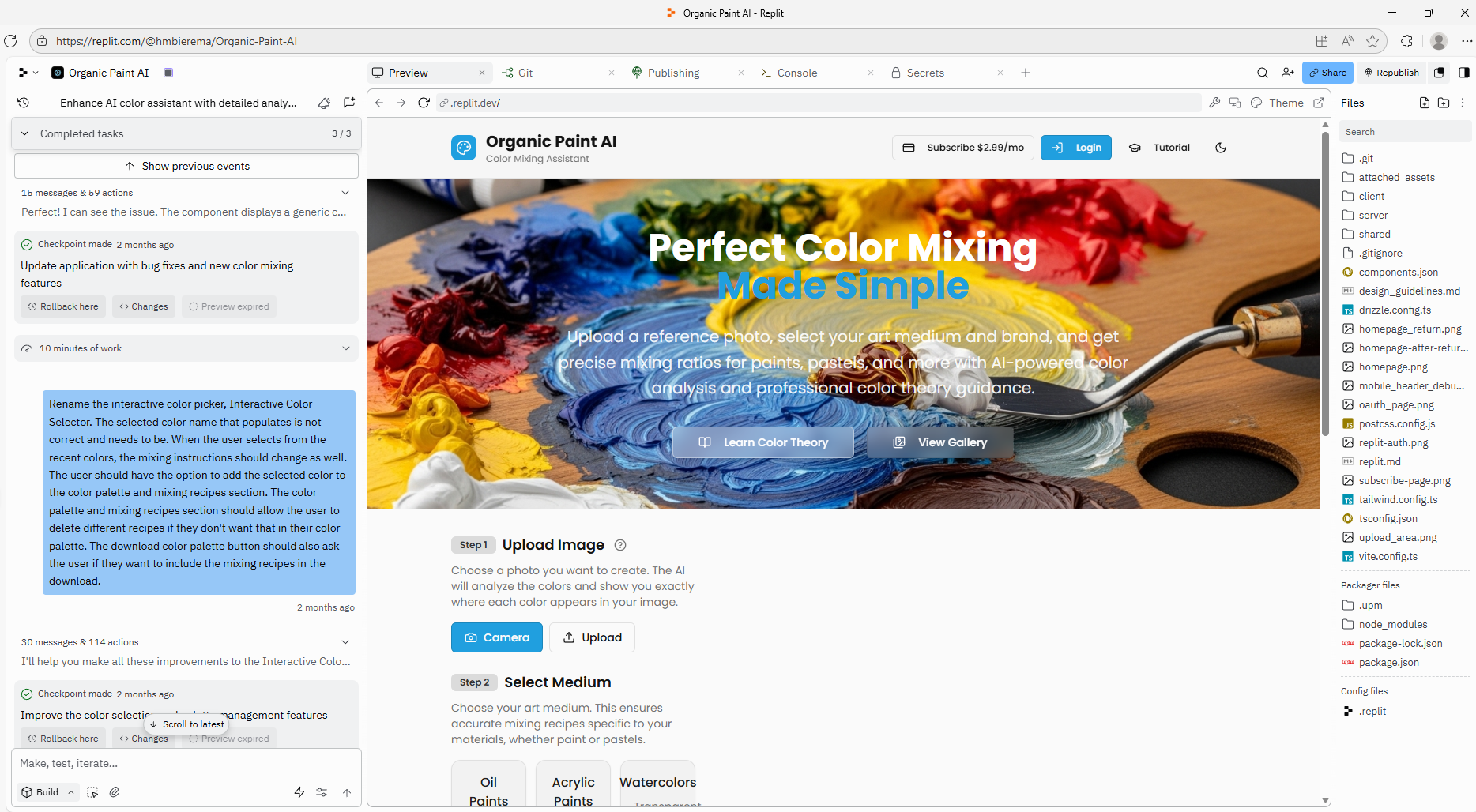
Replit dashboard showing prompt engineering for Organic Paint AI.
Outcomes, Impact, and Why the Tool Matters
The outcome of this project is a functional, human centered AI prototype that demonstrates how technology can meaningfully support creative practice without overtaking it. Organic Paint AI successfully identifies dominant and supporting colors from an uploaded image, translates those colors into practical pigment recipes across multiple paint mediums, and provides contextual guidance that helps artists make informed decisions. Rather than delivering a finished product, the tool offers understanding, which allows users to remain active participants in their creative process.
One of the most significant impacts of Organic Paint AI is how it reframes AI as an educational companion rather than an automated solution. Artists using the tool are encouraged to observe more carefully, question what they are seeing, and experiment with mixing rather than relying on shortcuts. This supports skill development and confidence, especially for beginners who often feel overwhelmed by color theory and pigment behavior. By breaking complex concepts into accessible explanations, the tool lowers barriers to entry while still respecting the depth of artistic practice.
From a usability and design perspective, the tool demonstrates how thoughtful UX decisions can shape trust and engagement. The interface prioritizes clarity and restraint, presenting information only when it adds value and avoiding unnecessary complexity. Each output is designed to feel supportive rather than prescriptive, giving users space to interpret and adapt suggestions based on their own materials and preferences. This approach reinforces autonomy and aligns with the broader goal of preserving creative agency.
The project also highlights the importance of ethical awareness in early-stage AI development. Even without large scale deployment, Organic Paint AI reflects deliberate choices around transparency, bias awareness, and responsible image handling. These considerations are embedded into the logic and communication of the tool, showing that ethical design does not need to be an afterthought or a separate phase. It can be integrated directly into the creative and technical process from the beginning.
On a professional level, this project demonstrates my ability to move from concept to execution while maintaining a clear design philosophy. It shows how I approach problem solving through research, iteration, and reflection, and how I balance innovation with responsibility. Organic Paint AI is not only a creative tool, but also a case study in building AI systems that respect users, support learning, and align with human values. Its impact lies not just in what it does, but in what it intentionally chooses not to do, and that distinction is central to why the project matters.
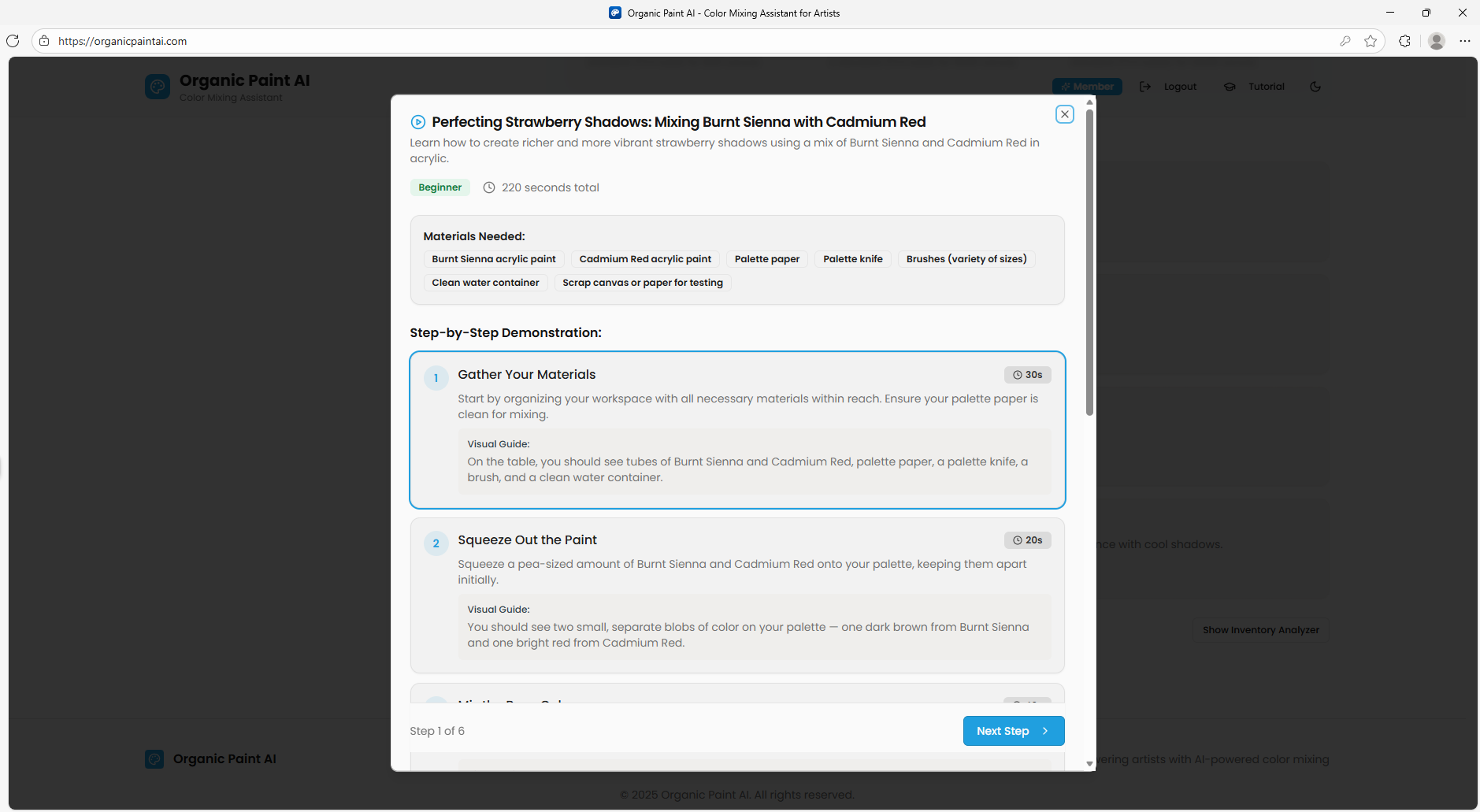
Learning tutorial for painting shadows with burnt sienna and cadmium red.
Challenges, Constraints, and What the Process Taught Me
Building Organic Paint AI surfaced challenges that extended far beyond technical execution, and each obstacle became an opportunity to refine both the tool and my approach as a designer. One of the earliest challenges involved translating visual color information into guidance that felt meaningful to artists rather than technically correct but creatively hollow. Early iterations of the tool identified colors accurately from a digital standpoint, yet the results did not always align with how artists perceive and mix pigments in practice. This disconnect forced me to slow down, revisit research on pigment behavior and color perception, and adjust the logic and prompting so the outputs reflected artistic reality rather than raw data.
Another significant challenge emerged through the development process in Replit using vibe coding. While this approach allowed rapid iteration, it also required extremely precise communication. Small changes in phrasing often produced dramatically different behaviors, and the system occasionally made assumptions that conflicted with the project’s intent. I learned quickly that effective prompting is not about volume or complexity, but about clarity, boundaries, and consistency. Each misinterpretation revealed where my own instructions needed refinement, reinforcing the importance of intentional communication when working with AI assisted development environments.
Balancing ambition with restraint was another constraint that shaped the project. It would have been easy to expand the tool toward generative outputs or automated decision making, especially as technical possibilities became clearer. Choosing not to do so required discipline and a strong commitment to the project’s purpose. I had to repeatedly evaluate whether a potential feature supported learning and creative agency, or whether it risked undermining the artist’s role. This process sharpened my ability to make principled design decisions, even when alternative paths might appear more impressive on the surface.
Time and testing limitations also presented challenges. While I designed a structured usability study and prepared for formal user testing, participation levels were not sufficient to produce quantitative results during this phase. Instead of viewing this as a failure, I treated it as a design reality and leaned into extensive personal testing and iterative refinement. This experience reinforced the value of adaptability and reminded me that meaningful insights can still emerge through careful observation, reflection, and disciplined iteration, even when ideal conditions are not yet in place.
Perhaps the most important lesson this project taught me is that responsible AI design requires patience and humility. It is not enough to make something functional or innovative; the tool must earn trust, respect user autonomy, and remain aligned with human values. Organic Paint AI challenged me to think critically at every stage, to question my assumptions, and to remain grounded in the lived experience of the people the tool is meant to serve. These lessons will continue to inform how I approach future projects, especially those involving emerging technologies and creative systems.
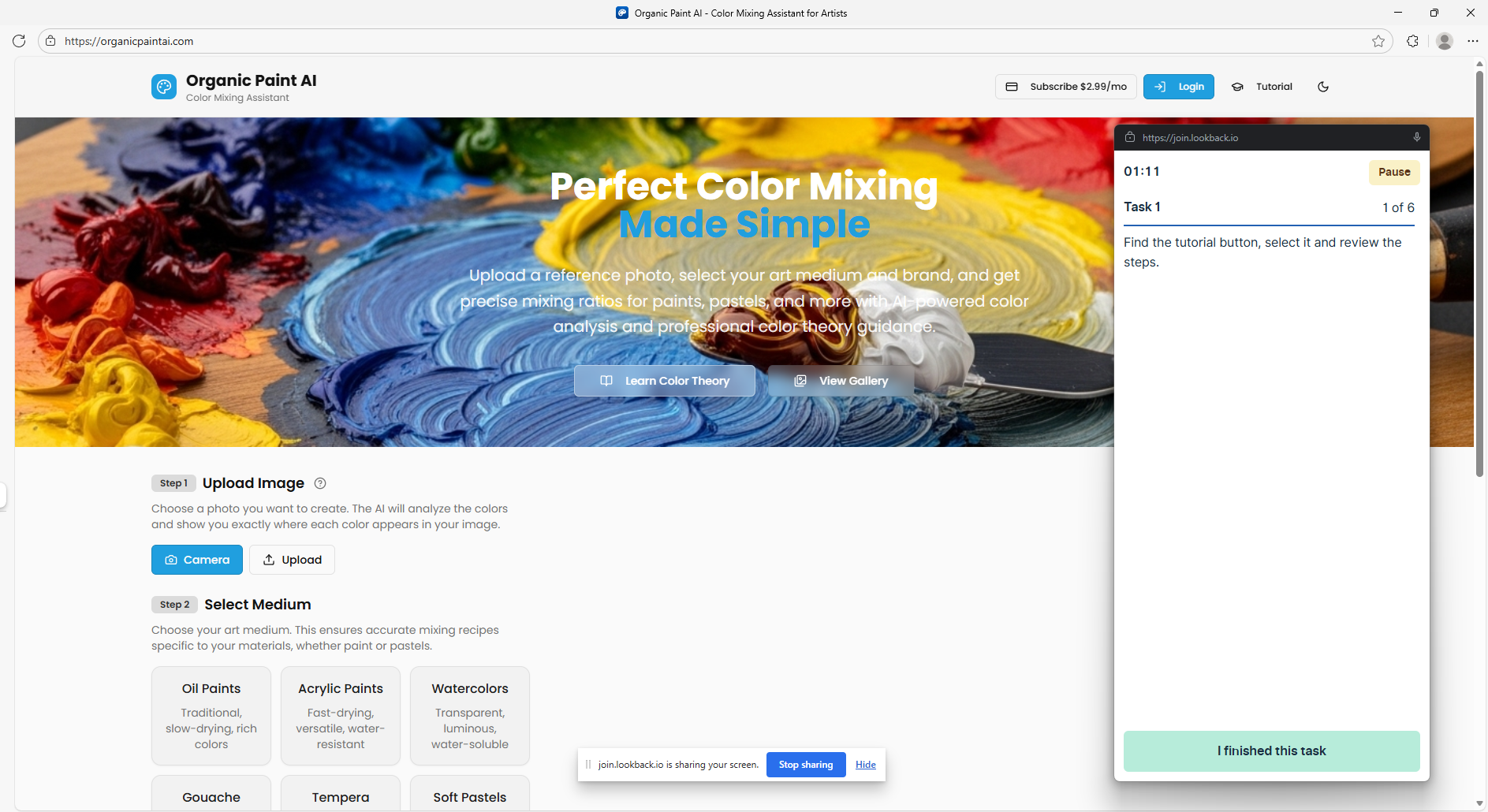
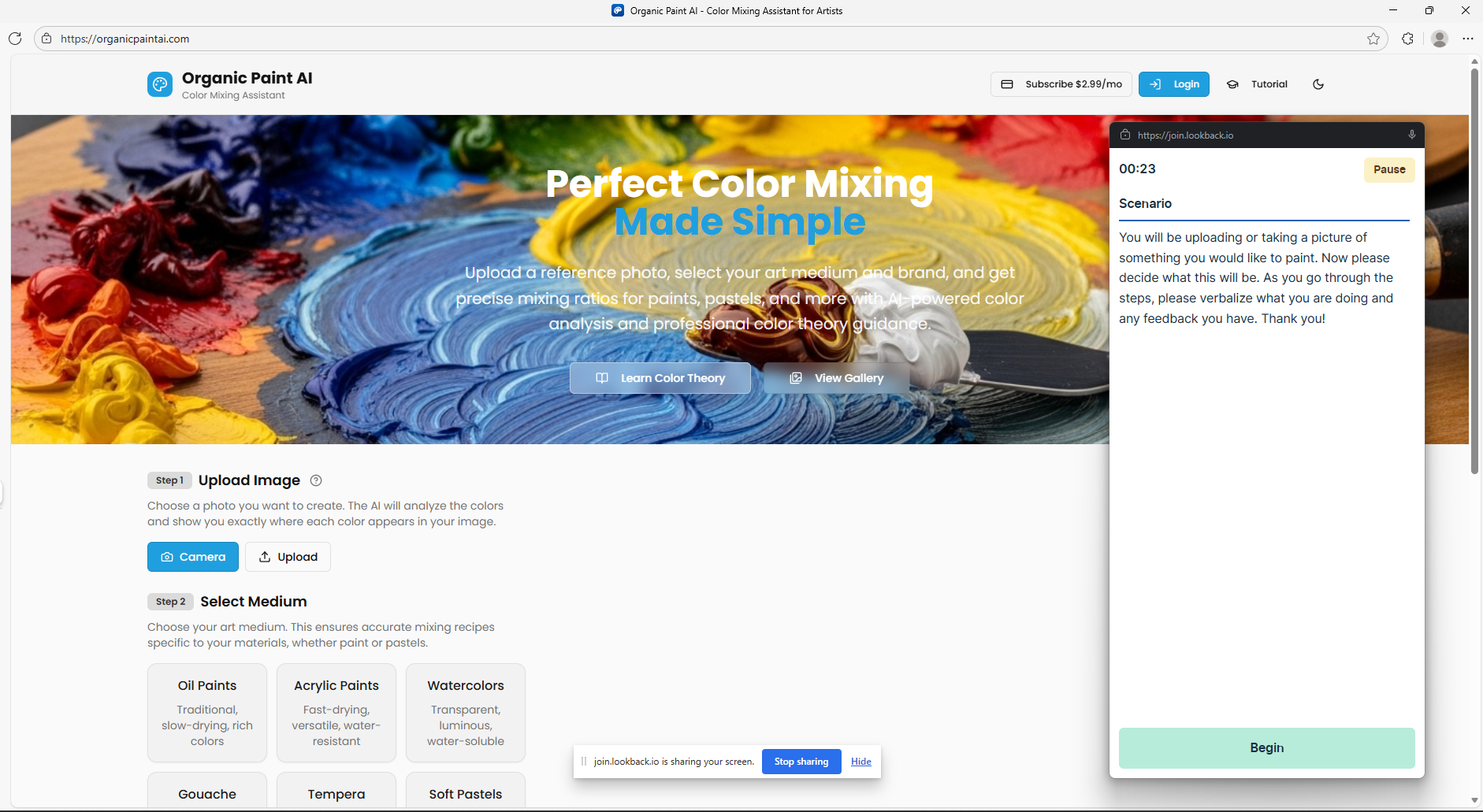
Examples of Lookback usability testing environment.
Why This Project Shapes How I Design Going Forward
Organic Paint AI represents more than a single project in my portfolio; it reflects how I approach design, technology, and responsibility as a creator. Through this work, I clarified that I am not interested in building tools simply because they are possible. I am interested in building tools that are thoughtful, intentional, and grounded in human experience. This project reinforced my belief that design decisions carry ethical weight, especially when technology has the power to reshape creative identity, learning processes, and professional practice.
Working at the intersection of AI, creativity, and user experience pushed me to think systemically. I had to consider not only how the interface functioned, but how the tool would be interpreted, trusted, and integrated into real creative workflows. This required balancing usability with education, flexibility with structure, and innovation with restraint. These are the same tensions that appear in professional product environments, particularly in roles that involve emerging technologies, platform design, or human centered AI systems.
This project also strengthened my confidence in navigating ambiguity. Organic Paint AI did not follow a linear path, and many decisions had to be made without clear precedents or established best practices. I learned how to move forward through research, iteration, and reflection, rather than waiting for certainty. That ability to make informed decisions in uncertain spaces is something I now see as a core strength, especially in fast evolving design and technology environments.
Most importantly, Organic Paint AI affirmed the kind of impact I want my work to have. I want to design systems that support learning rather than replace it, tools that empower people rather than diminish their agency, and experiences that respect the complexity of human creativity. This project sharpened my perspective on what ethical and human centered design looks like in practice, not just in theory.
As I move forward in my career, the lessons from this project will continue to guide my work. Whether I am designing digital products, AI assisted tools, or creative platforms, I will carry forward the same commitment to intentionality, transparency, and respect for the people who use what I build. Organic Paint AI is one expression of that philosophy, and it marks the direction I plan to keep going.
What Comes Next for Organic Paint AI
Organic Paint AI is not a finished destination for me; it is a foundation. The current version demonstrates how supportive AI can function in practice, but it also reveals how much potential exists when technology is designed to evolve alongside human learning and creative growth. Moving forward, my focus is not on expanding automation, but on deepening support, clarity, and accessibility for artists at different stages of their journey.
One of the most immediate areas for growth is the learning experience itself. While the tool already provides written guidance around color theory, mixing strategies, and pigment behavior, I plan to expand this into a more interactive educational space. This includes integrating short instructional videos, guided visual demonstrations, and step by step exercises that allow artists to move from observation to understanding to confident application. The goal is to meet users where they are, whether they are beginners building foundational skills or experienced artists refining their process.
Another important direction involves refining color interpretation across more complex conditions. Natural light, atmospheric shifts, textured surfaces, and reflective environments all influence how color is perceived. Future iterations of Organic Paint AI will continue to improve how these nuances are handled, ensuring that suggestions remain grounded in real world observation rather than simplified digital averages. This work will remain guided by research, testing, and careful iteration, rather than assumptions about what artists need.
Accessibility will also remain central as the project grows. I intend to continue improving clarity, readability, and interface flow, while also exploring ways to better support artists with color vision differences or varying learning preferences. Designing for inclusion is not an add on to this project; it is part of its core purpose, and future decisions will reflect that commitment.
Beyond the digital interface, the long-term vision for Organic Paint AI still points toward physical integration. The idea of a portable, mechanical palette that assists with color mixing in real time continues to guide my thinking. This direction reflects my belief that supportive AI should pull creators back into their materials, their environments, and their senses, rather than further into screens. While this concept remains exploratory, it represents the kind of future I am interested in building toward.
Ultimately, what comes next for Organic Paint AI is shaped by the same philosophy that defined its beginning. Growth does not mean doing more for the artist; it means helping the artist do more for themselves. As this project continues to evolve, it will remain grounded in intentional design, ethical awareness, and a deep respect for human creativity.
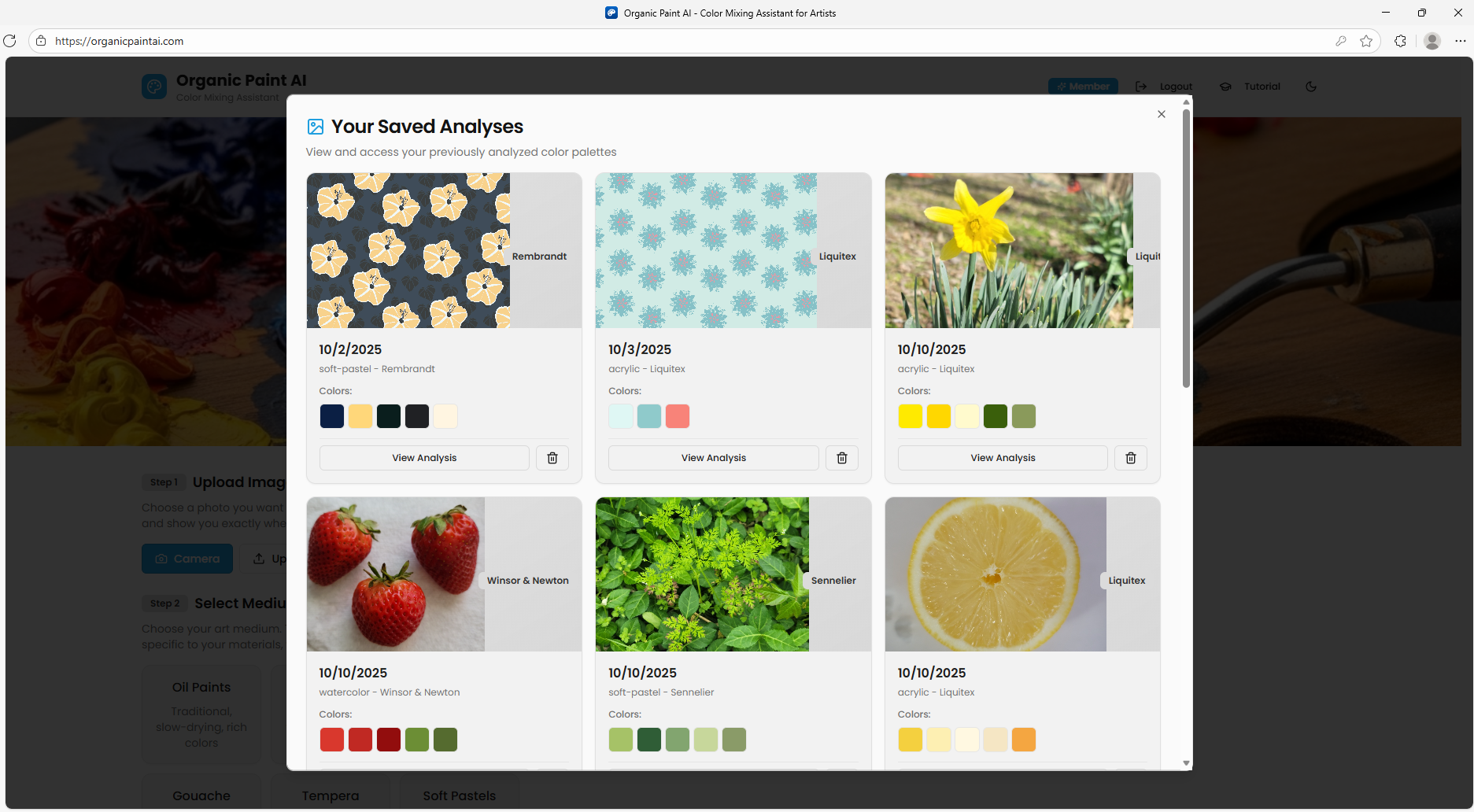
Saved analyses for photos uploaded to Organic Paint AI.
Why This Project Matters to Me as a Designer
Organic Paint AI represents more than a single project in my portfolio; it reflects how I think about technology, creativity, and responsibility as a designer. Working on this tool clarified the kind of problems I am drawn to solving and the kind of impact I want my work to have. I am not interested in building systems that remove people from their craft or replace the parts of creation that give it meaning. I am interested in designing tools that support learning, deepen understanding, and respect the human experience at the center of the process.
This project required me to move beyond surface level design decisions and engage with ethics, research, systems thinking, and real world constraints. I had to think carefully about how users interpret information, how bias can appear even in something as seemingly neutral as color, and how AI systems can quietly influence confidence and decision making. These considerations shaped not only the product, but also how I approach design more broadly. I learned that responsible design is not separate from creativity; it strengthens it.
Organic Paint AI also reflects my strength as a bridge builder between disciplines. I combined research, UX thinking, visual design, and AI assisted development to bring an abstract idea into a functional, usable form. I worked iteratively, tested assumptions, adjusted quickly, and stayed grounded in user needs, even when formal testing was still in progress. This process reinforced my ability to navigate ambiguity, translate complex concepts into accessible experiences, and maintain clarity of purpose throughout development.
Most importantly, this project affirmed my belief that technology should serve people, not overshadow them. Organic Paint AI is built around respect for artists, their time, their learning curves, and their connection to the physical world. That philosophy is not limited to art tools; it informs how I approach any design problem. Whether I am working on creative technology, UX systems, or data informed products, I bring the same commitment to intentionality, ethics, and human centered design.
This case study captures where I am as a designer right now and where I am headed. It reflects my values, my process, and my desire to build tools that contribute something thoughtful and lasting. Organic Paint AI is one example of that direction, and it represents the kind of work I am excited to continue doing.
Closing Reflection and Next Steps
Organic Paint AI is not a finished product; it is a living exploration of what supportive, human centered AI can look like when it is designed with care. This project represents a beginning rather than an endpoint, and it has opened the door to new questions about how technology can coexist with creativity without overpowering it. Each phase of development, from research to prompting to iteration, reinforced the importance of designing with intention and staying anchored to purpose, especially when working with emerging technologies.
Moving forward, I see Organic Paint AI continuing to grow in ways that deepen its educational value and real world usefulness. Expanding interactive tutorials, adding video based guidance, refining color interpretation in varied lighting conditions, and improving accessibility features are all natural next steps. Longer term, the vision extends beyond the screen and toward physical integration, exploring how tools like this could support artists directly in their environments through tactile, material focused experiences.
As a designer, this project strengthened my confidence in working at the intersection of creativity, ethics, and technology. It confirmed that I thrive in spaces where experimentation, research, and responsibility meet, and where design decisions carry real consequences for how people learn and create. Organic Paint AI reflects how I approach problem solving, not by chasing automation, but by asking what will genuinely support the user and honor their agency.
This case study is an invitation to see how I think, how I work, and what I value as a designer. I am excited to continue building tools that prioritize understanding over shortcuts, people over systems, and creativity over convenience. Organic Paint AI is one expression of that commitment, and I look forward to carrying these principles into future projects, teams, and collaborations.
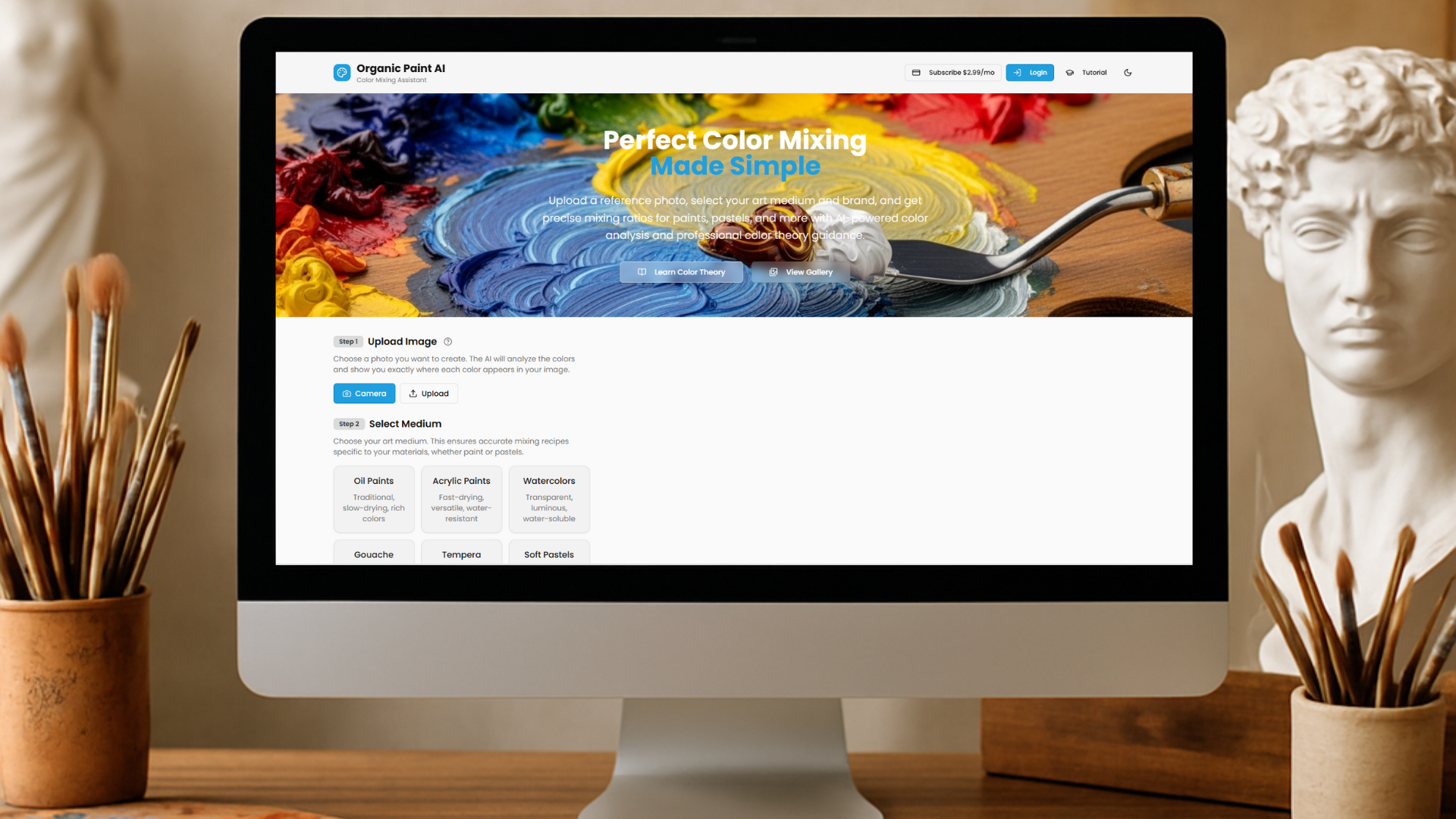
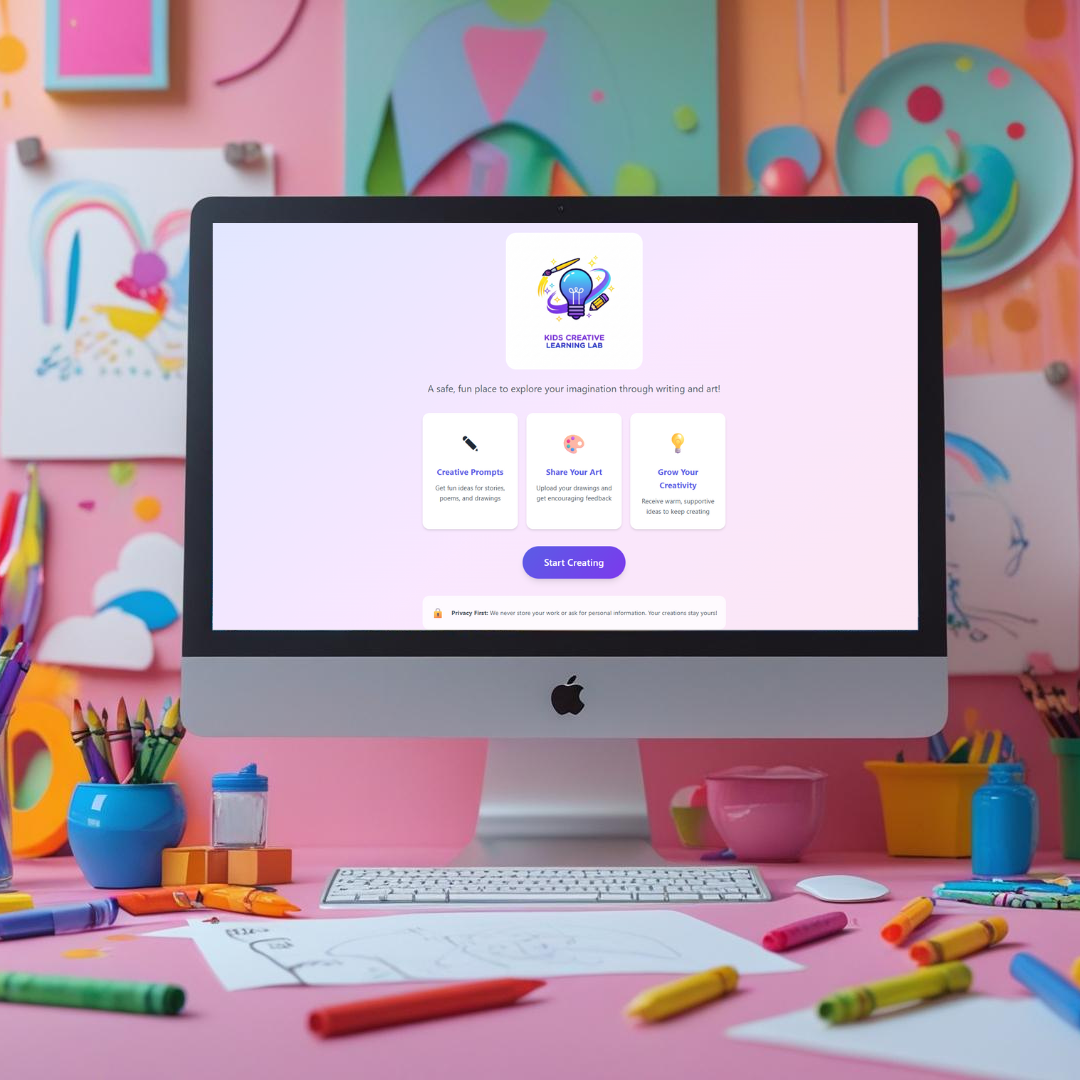
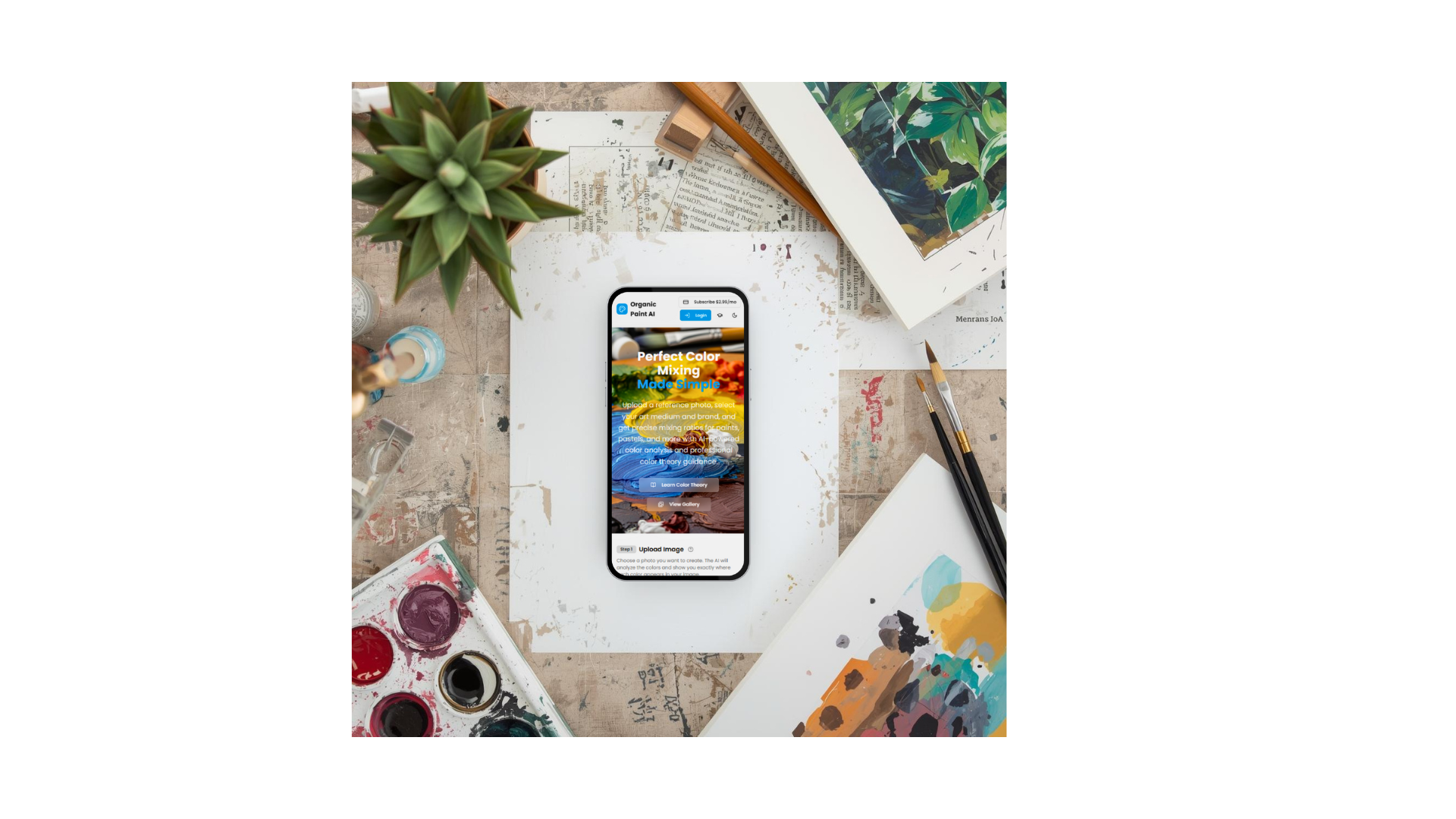
Main screen for Organic Paint AI when user first accesses tool.